UN LAB Middleware Label: Description Begins
UN INT Intro Text w/ Responsive Image - *Important Note* You must UNLINK this shared library component before making page-specific customizations.
EU leaders promised to reform chemical regulations – but they aren’t following through. Sign our open letter urging them to reconsider and seize the opportunity to restrict experiments on animals!
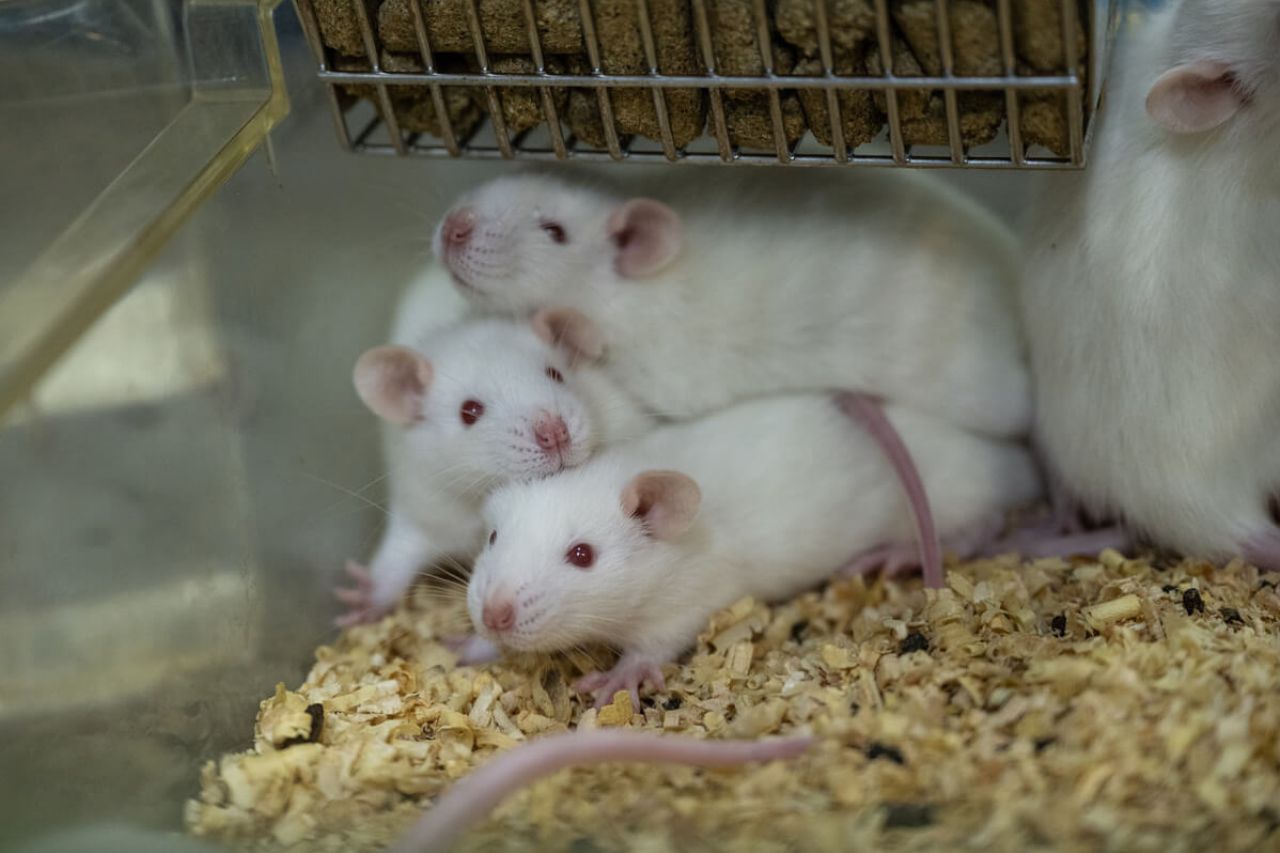
© Jo-Anne McArthur / Te Protejo / We Animals
The EU’s Registration, Evaluation, Authorisation and Restriction of Chemicals (REACH) legislation, introduced in 2006, was meant to protect human health and the environment and to ensure that animal testing is used only as a last resort. Yet experiments on animals are still approved even when non-animal assessment methods or existing data could prevent them. The issue is not a lack of scientific progress – it is the way the law is structured and applied.
It is essential that REACH be revised to ensure that the law works properly and protects animals. The Commission promised to do this in 2020, but it is now deciding whether to fully revise REACH or scale back on reform. Only a thorough and meaningful revision can properly stop animals from being used by default.
In 2023, after more than one million citizens backed the “Save cruelty-free cosmetics: commit to a Europe without animal testing” European Citizens’ Initiative, the European Commission committed to developing a roadmap to phase out animal testing for chemical safety assessments. It is essential that it puts words into action and starts this process of phasing out animal testing by updating REACH.
Animals Burned, Tortured, and Killed
Reports reveal that by 2022, more than 4.2 million animals had already been subjected to painful and often lethal tests mandated under REACH, including approximately 76,000 animals who had been used in skin or eye irritation tests or skin allergy tests, despite the availability of validated non-animal testing methods.
In chemical tests, rats have large quantities of chemicals forced down their throats every day for up to months at a time and fish gasp, tumble and eventually die in poisoned water. In reproductive toxicity tests, experimenters force-feed chemicals to pregnant rabbits to see whether the substances will cause their offspring to be born with abnormalities or die. Up to 2,500 animals may be used to test just one chemical in a single reproductive toxicity test.
Please sign our open letter urging the Commission to revise REACH and protect animals. The letter will be sent to the European Commission and may be shared with policymakers, decision-makers, and relevant media outlets. Complete the form below to add your name to the list of signatories.
If you have any questions or would like a copy of this letter to send on your own, please e-mail [email protected].
Open Letter
To: The European Commission
Dear Officials,
The requirement that animal testing be used only as a last resort must not be an empty promise. It must be rigorously applied in practice. Before any animal testing to meet REACH – the EU’s chemicals regulation – requirements is approved, companies must be required to demonstrate clearly and transparently that all non-animal, scientifically robust approaches have been explored and prioritised.
REACH needs an urgent upgrade. We’re calling for a modern, compassionate system that:
• Closes loopholes that allow animal experiments to continue, including those for cosmetics ingredients;
• Strengthens and clarifies the legal requirement that animal testing be used strictly as a last resort;
• Introduces a science-driven framework by replacing outdated test mandates with broader protection goals and information objectives that must be met through a robust, scientifically relevant approach that takes all information into account;
• Boosts transparency to cut painful and wasteful experiments on animals and accelerate non-animal innovation;
• Prioritises the use of cutting-edge non-animal methods for safety assessments;
• Restores public trust that EU law reflects both scientific progress and ethical responsibility.
The Commission has already committed to developing a roadmap to phase out animal testing for chemical safety assessments. REACH must now be brought into line with that commitment.
If the law continues to be interpreted in ways that default to animal testing, animals will remain trapped in laboratories — because outdated regulatory thinking is holding back scientific progress.
Thank you.
Yours sincerely,